Quick answer
The Fleet Tire Program at Fogg’s Automotive Fleet & Service Center in Scotia, NY, minutes from Schenectady, puts every unit’s tread depth on record at each PM, quotes LT and commercial tires per tire, and bundles mounting and balancing ($25–$40 per tire) and rotations ($25) into scheduled visits — so a tire is replaced on your calendar, not on the shoulder.
What’s included
- Tread depth in 32nds on every corner at every PM visit, logged per unit
- Pull points set per account (4/32″ winter work, 2/32″ legal floor); replacements grouped into planned visits
- LT and commercial tires quoted per tire by size and load rating; one standardized spec per vehicle class
- Mounting and computer balancing $25–$40 per tire; rotation $25, bundled into PM visits
- Flat repair (~$35, inside patch-plug) and same-day road-hazard replacement for fleet units
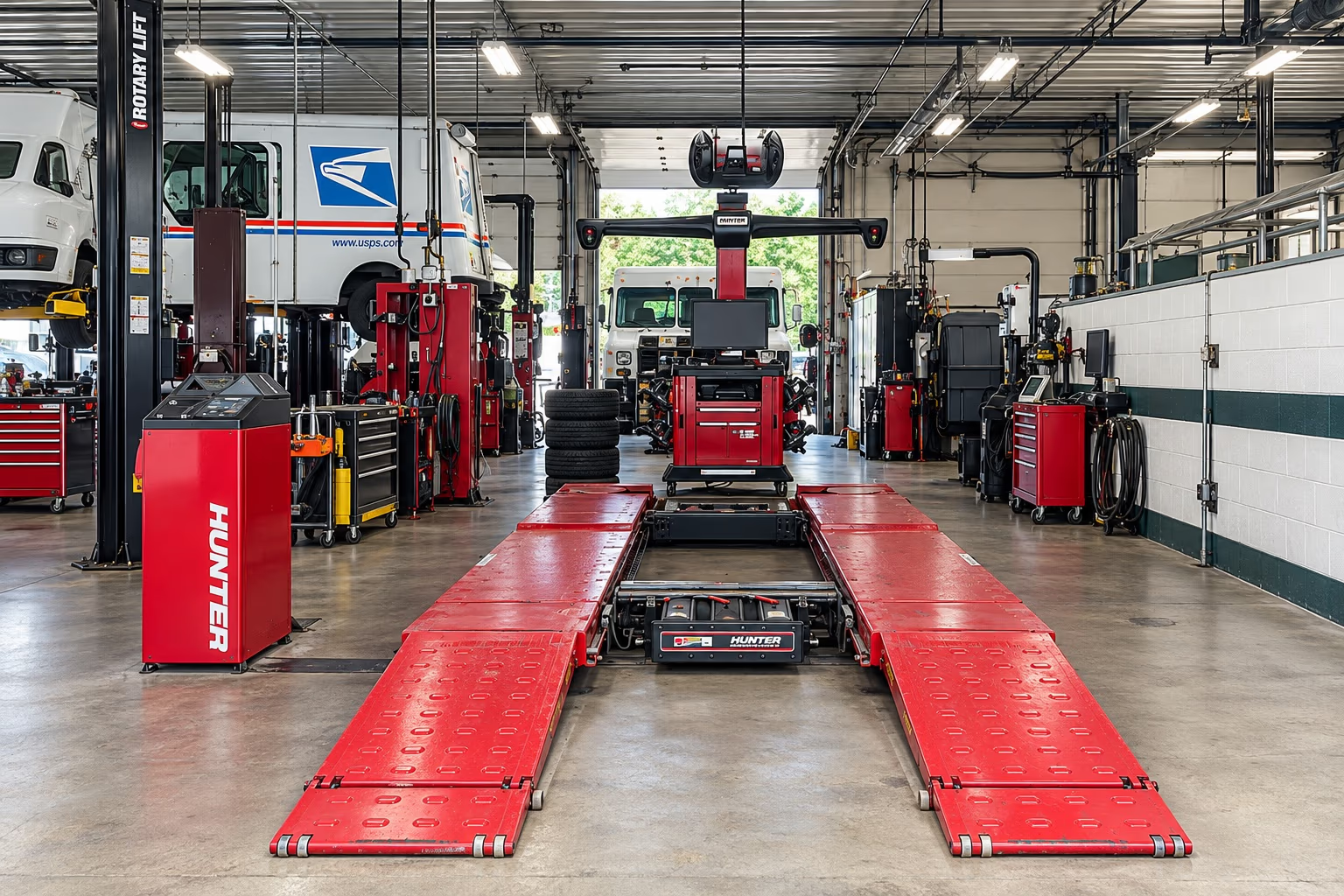
- Alignment check on the Hunter rack at tire replacement and after pothole or curb incidents
- TPMS service and programming, DOT date-code age tracking, staged winter changeovers
Signs you need this
- Tire spend is a line of emergencies, not a schedule
- Vans eating the inside edge of front tires every season
- Six brands in one size across identical units
- Nobody knows the tread depth of any vehicle until a driver reports cord
- Tires failing the NYS inspection at 2/32″
The full guide
After fuel, tires are usually the largest line in a light-duty fleet’s maintenance budget, and the one most often managed by emergency: a van runs until a driver notices cord, and the replacement is whatever the nearest store has in that size.
The Fleet Tire Program replaces that with measurement and a schedule — tread depth in 32nds on every corner at every PM, logged per unit, with pull points you set (4/32″ for vans that work through winter, 2/32″ as the legal floor the New York State inspection enforces) and replacements grouped into planned visits.
Read the full guideShow less
Fleet tires are quoted per tire by size and load rating, with good/better/best options and a recommendation based on what wears well on Capital Region roads.
We source the sizes fleets actually run — LT245/75R16 and LT245/75R17 on Super Duty and HD pickups, 235/65R16C and 225/75R16C on Transit and ProMaster, 245/75R16 on Express and Savana, 225/55R17 on Metris, 19.5-inch commercial sizes on E-450 and NPR-class cutaways — and standardize one spec across identical units so the account isn’t carrying six brands in one size.
Mounting and balancing is $25–$40 per tire, rotations $25 and bundled into the PM, flat repairs about $35 from the inside, and TPMS sensors serviced and programmed so the light means something.
Rotation and alignment are where tire money is actually saved. Loaded vans rotate at every oil interval — 5,000 to 7,500 miles — because the drive axle on a Transit or Express wears tires at a very different rate than the front.
Alignment is checked on the Hunter rack whenever tires are replaced and after any pothole or curb hit a driver reports; a van toed out an eighth of an inch after a Route 5 frost heave scrubs a new set to the belts in a season.
Tire age is tracked by DOT date code — a seven-year-old casing is a liability, not an asset.
Winter is part of the program.
New York permits studded tires from October 16 through April 30, and for routes that climb Glenridge Road or the Rotterdam hills a dedicated winter set on its own wheels — swapped in a staged changeover each November and April — stops and turns measurably better below 45°F than any all-season.
Flats and road hazards on fleet units are received the same day, repaired or replaced from the standardized spec, and coded to the unit on the monthly invoice.
The result is a tire cost per mile you can see by vehicle, instead of a line of surprises.
Also for one vehicle
Also for one truck: an owner-operator’s single van gets the same tread tracking, per-tire quote, and published mounting and rotation prices — the program is the method, not a minimum order.
Start a fleet accountCommon questions
How do you decide when a fleet tire gets replaced?
By measurement, against a pull point you set.
We log tread depth in 32nds on every corner at every PM, and when a unit reaches the account’s pull point — typically 4/32″ for vans that work through Capital Region winters, since New York fails a tire at 2/32″ and snow traction drops sharply below 4/32″ — the replacement is scheduled into the next visit.
Can you standardize tires across our vans?
Yes, and we recommend it. One spec per size and vehicle class — brand, model, load rating — means consistent handling across the fleet, predictable wear, simpler spares, and one quote to compare.
We propose a spec based on what wears well on local roads at your price tier, and every replacement on the account follows it.
How often should delivery vans rotate tires?
Every oil interval, 5,000–7,500 miles, bundled into the PM visit so it costs $25 and no extra downtime.
The drive axle on a loaded Transit, ProMaster, or Express wears tires at a very different rate than the steer axle, and without rotation you buy two tires every few months instead of four on a schedule.
Do our fleet vehicles need winter tires in Schenectady?
Not legally — New York doesn’t require them — but for routes with hills like Glenridge Road or the Northway grades, a dedicated winter set on its own wheels pays for itself in fewer weather incidents and shorter stops below 45°F.
Studded tires are legal October 16 through April 30.